Monday, January 23, 2017

Rock-Hewn Churches, Lalibela


In a mountainous region in the heart of Ethiopia, some 645 km from Addis Ababa, eleven medieval monolithic churches were carved out of rock. Their building is attributed to King Lalibela who set out to construct in the 12th century a ‘New Jerusalem’, after Muslim conquests halted Christian pilgrimages to the holy Land. Lalibela flourished after the decline of the Aksum Empire.


There are two main groups of churches – to the north of the river Jordan: Biete Medhani Alem  (House of the Saviour of the World), Biete  Mariam (House of Mary), Biete  Maskal (House of the Cross), Biete Denagel (House of Virgins), Biete Golgotha Mikael (House of Golgotha Mikael); and to the south of the river, Biete Amanuel (House of Emmanuel), Biete Qeddus Mercoreus (House of St. Mercoreos), Biete Abba Libanos (House of Abbot Libanos), Biete Gabriel Raphael (House of Gabriel Raphael), and Biete Lehem (House of Holy Bread). The eleventh church, Biete Ghiorgis (House of St. George), is isolated from the others, but connected by a system of trenches.
The churches were not constructed in a traditional way but rather were hewn from the living rock of monolithic blocks. These blocks were further chiselled out, forming doors, windows, columns, various floors, roofs etc. This gigantic work was further completed with an extensive system of drainage ditches, trenches and ceremonial passages, some with openings to hermit caves and catacombs.


Biete Medhani Alem, with its five aisles, is believed to be the largest monolithic church in the world, while Biete Ghiorgis has a remarkable cruciform plan. Most were probably used as churches from the outset, but Biete Mercoreos and Biete Gabriel Rafael may formerly have been royal residences. Several of the interiors are decorated with mural paintings.


Near the churches, the village of Lalibela has two storey round houses, constructed of local red stone, and known as the Lasta Tukuls. These exceptional churches have been the focus of pilgrimage for Coptic Christians since the 12th century.

Quick Facts on Rock-Hewn Churches, Lalibela

When was Lalibela built?
The 11 churches in Lalibela, Ethiopia were commissioned in the 12th Century when travel to the Hold Land became dangerous.
Built on stretches of volcanic tuff, workers carved down into the ground to form the churches inside and out.
In 1978 the churches became a UNESCO World Heritage site.

Who was King Lalibela?
Gebre Mesqel Lalibela (reigned early 13th century), also called simply Lalibela, which means "the bees recognise his sovereignty" in Old Agaw, was negus or king of Ethiopia and a member of the Zagwe dynasty. He is also considered a saint by the Ethiopian church.

When were churches built?

After the death of the Roman emperor Constantine in 337 A.D. Christians were allowed to have buildings to worship in. These first churches were built on a similar plan to Roman basilicas. This plan was later used for the fine Gothic cathedrals and churches that were built at the end of the Middle Ages.


Saturday, January 21, 2017

Mysterious UFO like image dated 10000 years old discovered in Chhattisgarh

Chhattisgarh state department of archaeology and culture plans to seek help from Nasa and Isro for research on 10,000-year-old rock paintings depicting aliens and UFOs in Charama region in Kanker district in tribal Bastar region


According to archaeologist JR Bhagat, these paintings have depicted aliens like those shown in Hollywood and Bollywood flicks. Located about 130km from Raipur, the caves come under village Chandeli and Gotitola.
.


here are several beliefs among locals in these villages. While few worship the paintings, others narrate stories they have heard from ancestors about "rohela people" — the small sized ones — who used to land from sky in a round shaped flying object and take away one or two persons of village who never returned.

"The paintings are done in natural colours that have hardly faded despite the years. The strangely carved figures are seen holding weapon-like objects and do not have clear features. Specially, the nose and mouth are missing. In few pictures, they are even shown wearing space suits. We can't refute possibility of imagination by prehistoric men but humans usually fancy such things," the archaeologist said.He added that it is a co-incidence that such ancient images appear to have sharp resemblance to UFOs shown in alien movies. "The fan-like antenna and three legs of vehicle's stand clearly show a similarity to UFO type craft," he said.

Hyperloop the next step for faster transport

 How it would be if we are able to travel to any part of India within 30 mins to 2.5 hrs ,would not be amazing ,well how is it possible .. well the answer is very simple Hyper loop.

 Hyperloop is US-based company which has embarked on an ambitious project to revolutionise the way people moved from one city to another has set its eyes on Chennai
.The brainchild of Elon Musk, HyperLoop One proposes to propel people in travel pods at 1,200kmph through a tube propped up on concrete pillars. The pod or train is able to achieve the speed because it floats in a vacuum inside the tunnel.
What is the Hyperloop?
The Hyperloop is a conceptual high-speed transportation system originally put forward by Elon Musk, incorporating reduced-pressure tubes in which pressurized capsules ride on an air cushion driven by linear induction motors and air compressors.

How is the Hyperloop powered?
Hyperloop is a proposed method of travel that would transport people at 745mph (1,200km/h) between distant locations. It was unveiled by Elon Musk in 2013, who said it could take passengers the 380 miles (610km) from LA to San Francisco in 30 minutes - half the time it takes a plane.


What is Hyperloop technologies?
Hyperloop Technologies is a United States company formed to explore Elon Musk's Hyperloop concept. One of its competitors is the crowdsourced Hyperloop Transportation Technologies. The company is currently building a short (1.9 mi (3 km)) test track in the Nevada desert to test lightweight prototype Hyperloop pods.

How does it works?
Hyperloop is based on three scientific principles.
Magnetism: The moving shuttle would be magnetically suspended within minutues  the vacuum tube without touching any part of the tunnel while it is traveling. So no contact, no friction.
Vacuum: The Hyperloop transport tube would be airless to virtually eradicate any air resistance.
Inertia: The Hyperloop technology uses nearly linear channels so the turns would be less sharp or there would be no turns at all. This ensures continuity of momentum without sharp turning points which serve as intermittent speed breakers.
All of the above mentioned factors give Hyperloop technology a great advantage over other four modes of transports, including air travel.


Jallikattu!! Why it's shouldn't be BAN

Jallikattu or Sallikkattu , also known as Eru thazhuvuthal  and Manju virattu , is a traditional spectacle in which a Brahman bull is released into a crowd of people. Multiple human participants attempt to grab and tightly "hug" the large hump of the bull and hang while the bull attempts to escape. Participants hug the hump for as long as possible, attempting to bring the bull to a stop.In some cases, participants must ride long enough to remove flags affixed to the bull's horns.

How old is Jallikattu?
Jallikattu has been known to be practiced during the Tamil classical period (400-100 BC).It was common among the ancient people Aayars who lived in the ‘Mullai’ geographical division of the ancient Tamil country.Later, it became a platform for display of bravery and prize money was introduced for participation encouragement. A seal from the Indus Valley Civilization depicting the practice is preserved in the National Museum, New Delhi. 

How is jallikattu associated to agriculture?
Native cattle have evolved over millennia, adapting to the local environmental conditions. They are an integral part of farming, especially for small and marginal farmers as they serve multiple purposes like ploughing, transportation, source for farmyard manure, organic treatments like panchagavya, jeevamritham, and as a source of A2 milk.Stud bulls are reared by people for jallikattu. The ones that win are much in demand for servicing the cows. Small farmers cannot afford to keep stud bulls, so each village has a common temple bull which services the cows of the village. Jallikattu is the show where bulls are brought and exhibited. The ones which are most agile (and virile) are preferred by farmers. The calves from such bulls are in demand.
The intricate connect between these events and farming can be seen from the chronological order in which showcase events like jallikattu happen first, then the shandies and then the main farming season starts. Once harvest is done, farmers take their bulls to participate in such events over the next few months; spectators and visitors make a note of the top bulls and seek them out in sandhais (cattle shandies/markets) which happen from December till April all over Tamil Nadu. The calves and bulls are bought for jallikattu and some of their offspring will be castrated and used as draught animals in transport/farming.


What is the breeding process?
Jallikattu is a system evolved over a period by Tamil society to conserve animal by allowing them to co exist in the habitat they live. It encourages the skill development of person who is involved in handling the animals and support In-situ conservation of a domesticated gene pool through gaming . This responsibility of In-situ conservation of gene pools & skill development has ensured harmonious society in Tamil society through Jallikattu.

Jallikattu & Breeding :
Tamil society always puts up a science behind a practice as preaching science also bores like preaching a religion. Though even in western world animal breeding was considered as a Science only after Sir Robert Bakewell (1725–1795) tamil society were practicing animal breeding as a science.
Jallikattu is one of the open system adopted by tamil society for selecting a gene pool for breeding and domestication .

Breeding is a boring and time consuming art & science. With out incentive it would be difficult to enthuse one who does this practice. Jallikattu/ Eru Thazuvuthal was a breeding system created with gaming & incentive to enthuse society for selecting a gene pool for breeding.

How does it indirectly effect us?
In order to know how it a effects us indirectly we need to the know about A1, A2,milk type.
Many of us do not know the difference between an Indian cow and a western cow. The cows you see on the streets now are hybrid-western cows. The poisonous A1 milk you now drink is from this breed. The indigenous cow breeds of our country has a hump on it's back and it gives nutritious, safe A2 milk. We had about 70 indigenous breeds which is now reduced to 30, thanks to the lobbying west and our mindless corrupt politicians. And this 30 left overs are also waiting to go extinct, thanks to the slaughter houses and the ban on Jallikattu and bullock cart racing. 

 The milk you get from Aavin and other companies are toxic A1 milk. Cow's milk contains proteins, fats, carbohydrates (in the form of lactose), minerals and water. There are two types of cow's milk : A1 & A2. The main difference between the A1 & A2 milk is their protein component. The protein is of two types : Casein and Whey. There are different types of casein proteins and one particular type is called the BETA-CASEIN which has two variations : A1 & A2. The A1 beta casein is a highly toxic component while the A2 is harmless and safe. Your mother's milk is A2 and so is the Indian cow's. It has micronutrients like cytokines and minerals which enhances your immune system. But the western cow's milk which we drink today, is highly toxic and not suitable for human consumption. 
 
Bottom line is, once people drink milk, the western cow's milk (which contains A1 beta casein) digests differently than the Indian Cow's milk (which has A2 beta casein). With the A1 beta casein, there's a release of a 'peptide' which a small fragment of protein called " Beta-Caso-Morphin-7 " the devil in the milk.
The BCM7 is an opioid (psychoactive chemical) and when it gets through from the stomach into the blood, it can cause all sorts of problems. The human body simply doesn't like this opioid and it tries to react against it, and depending on the individual's genetic make up, one could get all sorts of diseases ranging from juvenile diabetes, autism, allergies and etc. To make it worse, BCM7 crosses the Blood Brain Barrier. Which means, it could get in to your brain, resulting in schizophrenia and auto-immune diseases such as MS and Parkinson's. In children, it could cause several issues for their psychomotor and physical development (a recent study made by Russian scientists has confirmed this). 
 
The west has now woken up to the truth and more and more people are going to A2 milk. This has made the western diary industry nervous. So they're in the process of converting their useless, toxic A1 cows to A2 cows. They come to India for the A2 cow embryos as a result of which, now some of our wonderful native breeds like the Punganur and Vechur cows are nearly extinct. And thanks to the lack of a mechanism to check the illegal export of embryos at Indian sea ports, they're doing this with no issues. Today we see western humpless cow in indian diaries , and Indian humped cow in western diaries. Aavin and other milks we get in India now is the toxic A1 kind. The Indian hospitals and doctors are well aware of the health issues caused by the A1 milk, but they keep quiet. After all the business is booming right?

How did this corruption of native breed started? 


The White Revolution Of India (should be read as 'The Ethnic Cleansing Of Desi Cows" )
It all began in the early 1960s.So supposedly, back in the early 60s, India wanted to improve her milk production and wanted to become milk sufficient. So she started the 'White revolution" a project by the National Dairy Development Board (NDDB) which was the world's biggest dairy development program. Now, you may think this program was about improving the values, knowledge, ethnoveterinary practices, healers and the local biodiversity associated with the native Indian breeds to make the Indian cows more productive, but you're wrong. This was a program devised by the western cattle industries who wanted to make moolah out of the gullible Indian public. They propagated 'mix breeding' as a solution to improve the milk yield of the Indian cattle. And through heavy lobbying, there were able to make our government agree! So instead of improving the milk production of the Indian cows like any sane government would do, Our tax money was spent in buying the exotic western bulls and semen, which made the western cattle industry very happy. They even made our government pass laws that will prohibit breeding of cows with Indian bulls without a license! One good example would be the Kerala livestock act of 1962, which PROHIBITS the maintenance of productive, indigenous bulls by the farmers. If you happened to have a bull that can mate, the agri inspector will come and cut it's balls off!!. Such has been the power of the lobbying west!
So friends let's not poison the milk our future generations consume and leave them with this curse. Let's unite together for  greater cause by saving jallikattu and saving out native cattle breed
Please support jallikattu. Jai hind !! 

Source :Wikipedia, wire, Quora

Thursday, January 19, 2017

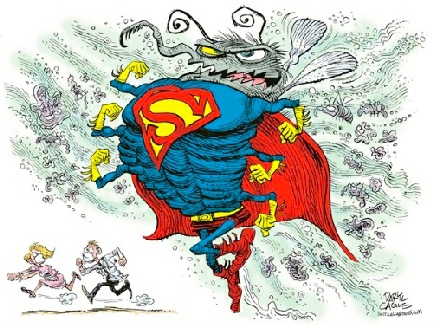
Superbug : A nightmare that started to unveiled


What is a Antibiotics?
Antibiotics are medicines used to treat infections or diseases caused by bacteria (e.g. respiratory tract infections such as pneumonia and whooping cough). Antibiotics are used for a range of other infections caused by bacteria, including urinary tract infections, skin infections and infected wounds.

How do antibiotics work?

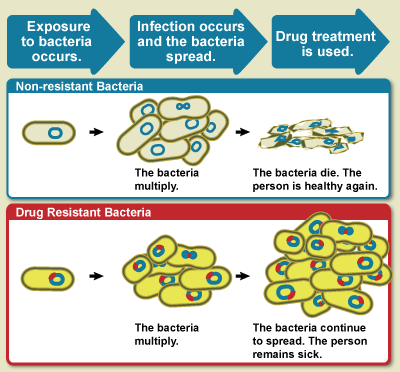
Some antibiotics work by killing germs (bacteria or the parasite). This is often done by interfering with the structure of the cell wall of the bacterium or parasite. Some work by stopping bacteria or the parasite from multiplying.

Ok What if a Antibiotics does not works on your body?Is it really possible that antibiotics does not works on our body.

 Well, the answer is YES !!

Here is a case that happened in United States.

And such infections it maybe Bacteria or Virus ,and its termed as "Super Bug"

 A woman in the US died after being infected by a superbug during her visit to India, say doctors who found that the ‘nightmare’ bacteria was resistant to all available antibiotics.

The infection was caused by carbapenem-resistant Enterobacteriaceae (CRE), a multidrug-resistant organism associated with high mortality.

While CRE are not new to the US, what was new in this case is that the infection was resistant or non-susceptible to all available antimicrobial drugs, researchers said.

The 70-year-old patient in the US was admitted to an acute care hospital last year after an extended trip to India.

She was given a primary diagnosis of systemic inflammatory response syndrome, likely resulting from an infected right hip seroma. The infection was serious – none of the 14 antibiotics physicians used to treat the woman worked.

After the CRE – identified as Klebsiella pneumoniae – was confirmed by lab testing, an isolate from a wound specimen was sent to the US Center for Disease Control and Prevention (CDC) for further susceptibility testing and to determine the mechanism of resistance.

That testing confirmed the presence of New Delhi metallo-beta-lactamase (NDM-1), an enzyme that directly breaks down carbapenems, a powerful class of antibiotics that are often used to treat multidrug-resistant infections.

The CDC’s antimicrobial testing showed the isolate was resistant to 26 different antibiotics, including all aminoglycosides and polymixins – another class of last-resort antibiotics.

It was also intermittently resistant to tigecycline, an antibiotic developed specifically to overcome drug-resistant organisms. Essentially, there were no treatment options.

Meanwhile, the patients condition was deteriorating quickly. She died of septic shock in early September last year, less than two months after admission.

The woman had been in India for two years and had been hospitalized at least four times for a right femur fracture and a subsequent hip fracture.

“We feel comfortable saying that she most likely obtained the bug in India,” said Lei Chen, senior epidemiologist with the Washoe County Health District in the US.

CRE have been labelled as a “nightmare” bacteria not only because they are already resistant to most antibiotics, but also because they spread easily in hospital settings.

Devi Asavari- Lord Shiva's Sister

Did you know that Lord Shiva also had a sister? Many of who you would question this belief, as to how the one whose existence is beyond birth and death, can have a sister?
But it is in fact true, if going by legends mentioned in Shiv Purana. Devi Asavari was created by Lord Shiva, on his wife Goddess Parvati’s insistence.

After their marriage, when Goddess Parvati came to Kailasha, she missed her family and sisters. Although, she was always taken care of by Lord Shiva’s beloved devotee, Nandi, Parvati still felt the need to have a companion.She expressed her desire to Lord Shiva, wishing to have sister-like companion on Kailasha, with whom she could share her thoughts, and spend her day with, when he’s away meditating.As Kailasha was swarmed with men, Goddess Parvati was the only women, who lived there. He gently asked her if this is what she wanted.

Her insistence convinced Lord Shiva, so he obliged to her demand. Although he told her that he would only create his sister, if Parvati promises to take care of her for the rest of her life.An eager Parvati, happily agreed. Being the God of Dead, Lord Shiva had no idea of how to create a woman, so, with all his sacred powers and knowledge, he formed a woman, similar to him.She was quite plump, with long and open hair (unkepmt), cracked feet; wearing nothing, but animal skin.Lord Shiva took her to Goddess Parvati and introduced her as his sister Devi Asavari. Parvati was happy to have finally got a sister-in-law. She bathed her, and provided her new clothes to wear.

Devi Asavari, asked Goddess Parvati to feed her from her kitchen. Parvati prepared scrumptious meals, and offered them to Asavari, who ate it all in once; she kept asking for more, until all the food from Kailasha was finished, leaving Goddess Parvati helpless.When Goddess Parvati was on her way to Lord Shiva, to seek his help into satiating Asavari’s appetite, the latter tripped her and mischievously hid her in the cracks of her heel. Lord Shiva, who knew it all, came to Parvati’s aid.

Pretending to be unaware, he politely asked Asavari about Parvati’s whereabouts. She lied to him saying, “How would I know, where did sister Parvati go?” Knowing her lies, he warned her. Asavari ultimately admitted and jerked her foot so hard that Goddess Parvati fell out her the cracked heel.Hurt and upset by her discourtesy and rudeness, Parvati asked her to leave Kailasha. Lord Shiva, reminded her of the promise to ‘take care of Asavari’, to which Parvati asked for forgiveness and explained her inability to have Asavari on Kailasha.Lord Shiva decided to instill some good behavior in Asavari and then marry her off, to which Parvati said, “If Asavari will become more polite, and full of manners, then I do wouldn’t have any problems, having her here on Kailasha.”

Malcha Mahal

Malcha Mahal is located in Malcha, one of the historical villages around Raisina Hill. Malcha, along with Raisina, Todapur, Aliganj, Pillanji, Jaisinghpura, and Kushak villages was moved by the British during the construction of capital New Delhi in 1920s, especially the Viceroy's House, which is now known as the Rashtrapati Bhavan.


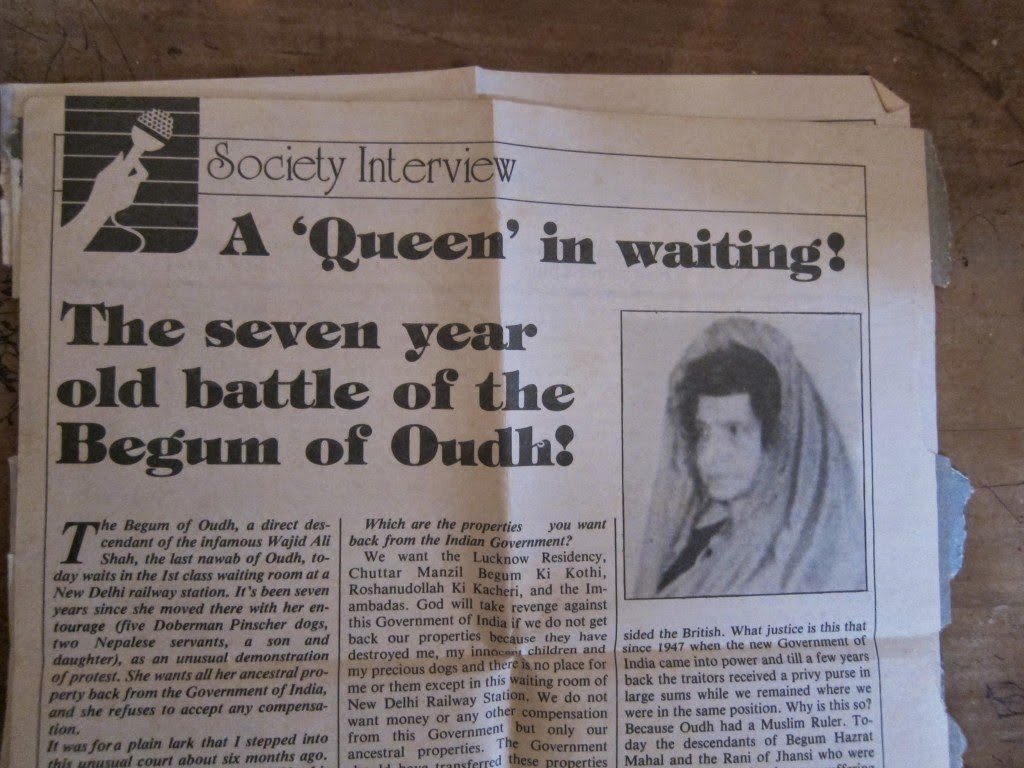
Malcha Mahal, also known as Wilayat Mahal, is a Tughlak era hunting lodge in the Chanakyapuri area of New Delhi, India next to the Delhi Earth Station of the Indian Space Research Organisation. It was built by Firuz Shah Tughlaq, who reigned over the Sultanate of Delhi, in 1325. It was renamed to Wilayat Mahal after Begum Wilayat Mahal of Awadh who was reportedly given the place by the Government of India in May 1985. On 10 September 1993, Begum committed suicide at the age of 62 by consuming crushed diamonds.

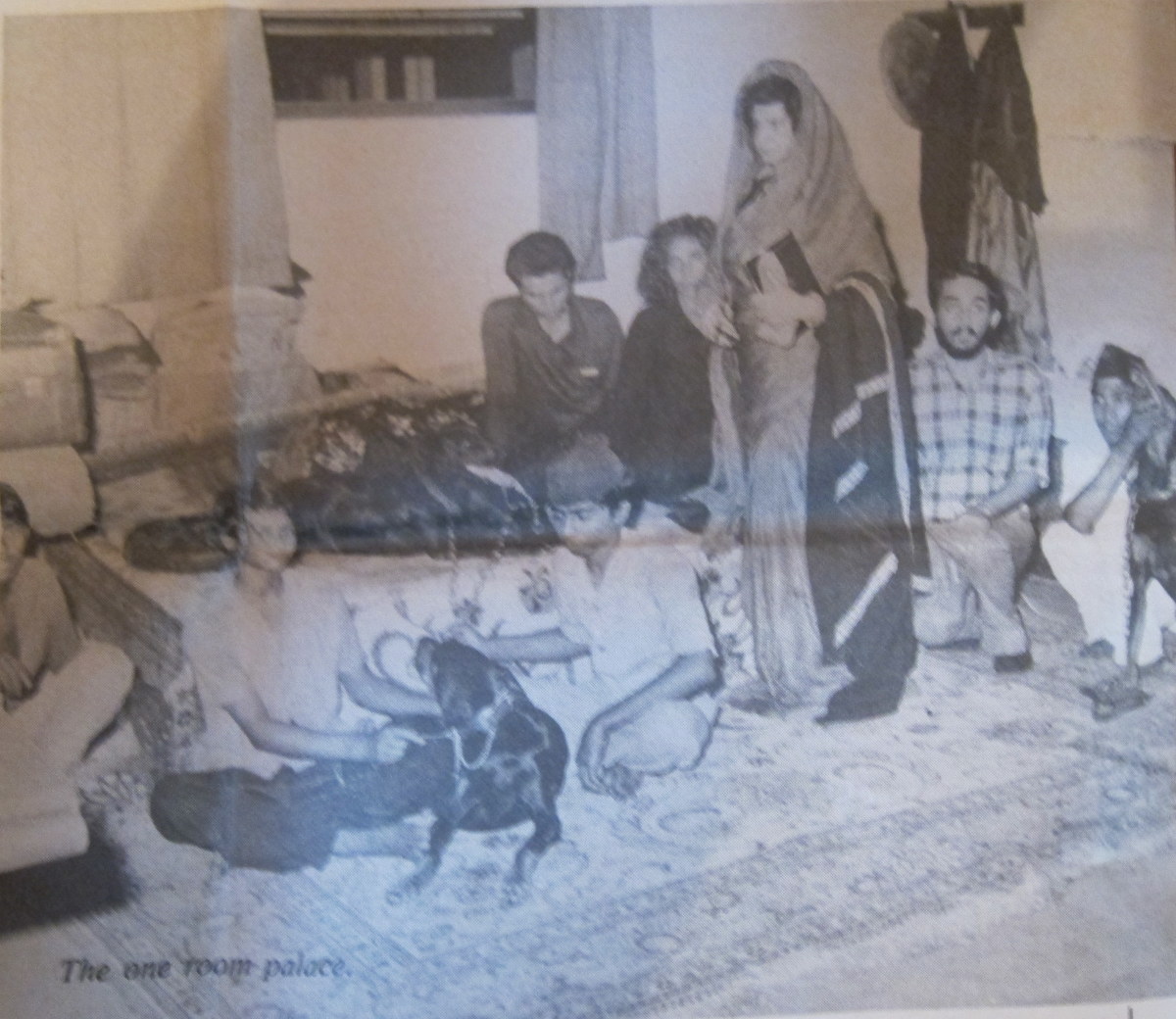
The building is now mostly in ruins, though it is still inhabited by the Begum's daughter Sakina Mahal, and son Prince Ali Raza. During her battle with Government she housed herself along with her two kids in a in the VIP lounge of railway station in delhi for nine years. In the 1985, Government finally allotted Malcha Mahal to these descendants. This was surely not less than a ghostly place for a human being full of lizards, snakes, and other insects.

In December 1993, out of stress and pain Begum Wilayat Mahal committed suicide by drinking crushed pieces of diamonds. But she left behind her two kids Prince Riaz and Princess Sakina, few Dobermans and some royal treasure. The body of begum was lying on her study table for ten days while her kids mourning with grief these days near to her body. Both the kids slept with the dead body a night prior to bury her body.

After some months few people tried to attack the kids in the search of royal treasure. The frightened siblings dig the grave of their mother and burned her body from being vandalized. The siblings have kept the ashes in a crystal Vial where she was graves till the date. There are many attempts by the thiefs who had once stolen the large silver table some gold and silver tableware from the Mahal.

From then these siblings are staying in the Malcha Mahal without any water, electricity, doors or even windows. They have no connection with the outside world. Even there is no kitchen in the palace. Prince only often come outside hiding his face for water and other basic amenities, often here implies to months.

Prince has been provided a gun and its license to shoot in self-protection by the Lt. Governor of Delhi in 1990’s when they were attacked. Due to terror and pain these siblings havenot talk to outside world since years.

From so many years they are surviving on the treasure which their mother has left for them which might have been vanished by now. Now they have no one to trust since they are betrayed by their servants, journalists who misquoted them and government officials who had broken their promise.

The siblings have just given two interviews by far. They don’t let anyone inside the palace if someone tries to come they leave their dogs on them.

Once someone has the chance to see Sakina full of trenches in the face, sad wild hair although her English was flawless. Both the kids are bright but burdened under the sorrows of the Oudh house. It has been from the facts the siblings have been reached to mid age roughly 50-55 years.

Some people call Malcha Mahal a haunted house or ghostly house but the real ghost is the time who has put these royal siblings in the dense forests without basic amenities since ages.

In an interview in the starting years it Prince said that he would die before his sister and then Sakina would commit suicide in the royal way of eating crushed diamonds. It was asked to him if she dies first on which he replied I have not decided for that now.