Saturday, November 13, 2010
Giant Sinkhole in Guatemala
The first named storm of the 2010 Pacific season dumped more than a metre of rain in parts of Guatemala, also hitting El Salvador and Honduras. At least 113 people were reported killed, with around 50 missing in Guatemala alone as rescue workers searched through the rubble.
The 30m-diameter sinkhole opened up in a northern district of Guatemala City, with residents blaming the rains and substandard drainage systems. Local reports said one man was killed when the building was swallowed. In 2007, three people died when a similar sinkhole appeared in the same area.
Guatemala was the worst affected country, with a confirmed death toll of 92, although that is likely to rise when rescuers reach remote villages. Almost 100,000 people have been evacuated from their homes. Nine people were confirmed killed in El Salvador and 12 in Honduras.
"I've got no one to help me. I watched the water take everything," Carlota Ramos told Reuters outside her mud-swamped brick house in Amatitlán, a town near the Guatemalan capital.
Source: National Geographic
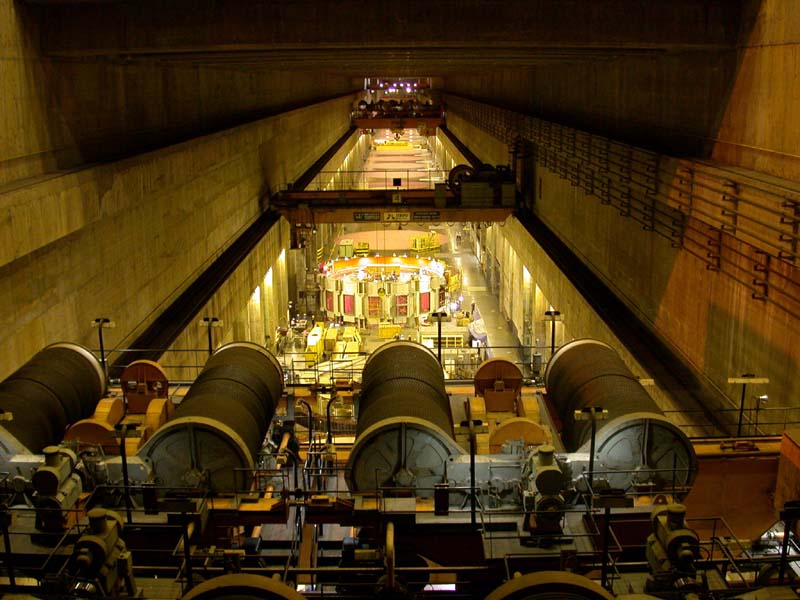
2nd Biggest Electrical Power Plant on Earth is in Brazil/Paraguay
Dimensions: length: 986 m, maximum height: 112 m and width: 99m.
The red line on the floor indicates the border of Brazil and Paraguay .
The control center of the 18 generators Left half of it (in Brazil ) controls the 60 Hz units, right half (in Paraguay ) controls the 50 Hz units. A 18 kV to 525 kV transformator for 825 MVA
To increase the voltage of the generators, transformers with a capacity of 825 MVA and 768 MVA(for 50 and 60 Hz respectively) were specified.
Power switches for high voltages
Power switches at the "Left Bank Substation" (FURNAS). The AC-DC rectifier
The FURNAS rectifier substation is accomplished by four lines of of 500 kV.
Output DC voltages are symmetrical ± 500 000 Volt SC.
Electricity (AC) leaving ITAPU to Sao Paulo
6 300 MW of electrical power generated by the 60 Hz units is transported by an 891 km AC transmission system, formed by three lines of 750 kV.
"Peanuts"- a word often used from so called "economic experts" and representatives when it comes to Renewable Energies.
"Not sufficient", "unreliable", "not feasible", are common bias.
Total view of the ITAIPU power plant
Left part shows overflow (spillway), the power station is located in the middle.
At the bottom of the 196 m tall dam
On top of the 7.6 km dam
A 12 800 000 m³ of concrete was used for the project ITAIPU.
Its area reaches 1 350 km2, its length 170 km and its average width 7 km.
ITAIPU shows they are wrong! Having more power than 10 nuclear power stations it supplies the second largest city on the planet with zero-emission electricity since 1984, still being extended until 1991. 26% of the electrical power consumption of Brazil and 78% of Paraguay are supplied by ITAIPU.
Located at the Brazilian-Paraguaian border and not far from the Argentinian border, the first step of the initiation was already in 1966 when the Ministers of Foreign Affairs of Brazil and Paraguay signed a joint statement known as the "Act of Ygazu". By this a study and evaluation of the hydraulic resources of the Parana river (owned jointly by Brazil and Paraguay ) followed.
On April, 26, 1973, the two governments of the states signed a treaty "for the development of the hydroelectric resources of the Parana River " and founded "ITAIPU Binacional" (cooperation with the legal, administrative and financial capacities and technical responsibility to plan, set up and operate the plant) in May, 17, 1974.
The construction work started in 1975, reaching its peak in 1978 with 30 000 people at work. Monthly on-site concrete production reached 338 000 m³. In total, 15 times the mass of concrete used for the "Eurotunnel" was supplied. The height of the dam reaches 196 m, its length 7.76 km. The lake created by this is 170 km long and contains 29 billion tons of water.
Unit 1 started to operate in December 1983. Electrical grid connection to Paraguay was established in March 1984, Brazil was connected 5 months later. In March 1991 the last unit ( No.18) was put into operation.
The water intake of one single 715 MW Francis-turbine is 700 m³/s, its weighted efficiency is 93.8%.
Each year ITAPU generates 75 TWh of electricity and avoids 67.5 million tons of carbon dioxide emissions - compared to coal power plants.
The final cost of ITAIPU amounts to US$ 20 billion, 50% of this value are direct investments and balance financial charges.
If whole area of the lake - at nominal level - would be covered by solar modules the power of the would be 135 000 MW p, which would produce 230 TWh a year. For the same yearly output as ITAIPU a solar PV-plant would cost US$ 132 billion
Friday, November 12, 2010
1st Indian Sikh Soldier in US Army
Lamba came to the US about four years ago and earned his master’s degree in industrial engineering at New York University. The US Army has two Sikhs who became medical officers over the past year, but it hasn’t had one in the enlisted ranks. Although Lamba was initially told that his Sikh articles of faith would be accommodated, his formal request on this score was denied. Lamba then appealed the decision and his appeal was accepted. Lamba wore a helmet over a small turban during field exercises.The US Army used to have a substantial number of Sikh soldiers early on, with many serving as far back as World War I.But the Army’s 1981 stipulation banning conspicuous religious articles of faith, including turbans and unshorn hair, dissuaded Sikhs from joining the force.
Wednesday, November 10, 2010
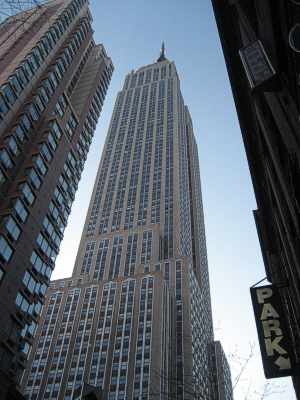
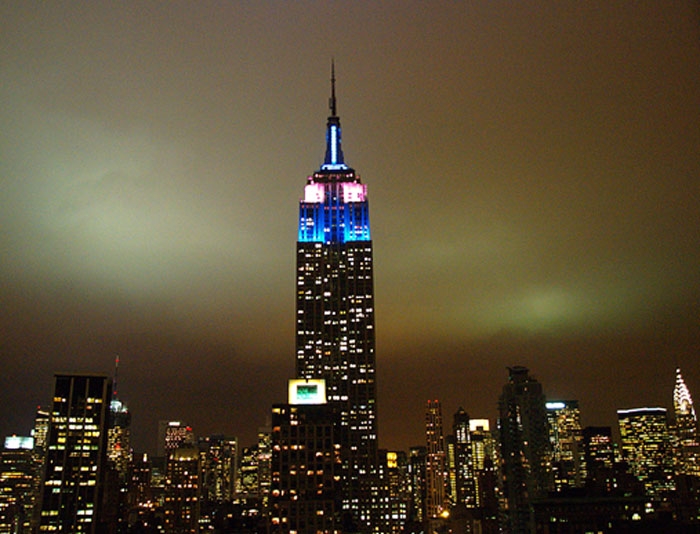
Empire State Building,USA
Where is the Empire State Building located?
The Empire State Building is located at 350 Fifth Avenue (between 33rd and 34th Streets) in New York City.
How tall is it?
There are several numbers to describe the height of the Empire State Building. The total height of the building, including the lightning rod, is 1,454 feet. The height of the building from the ground to its tip is usually given as 1,250 feet. The measurement from the ground to the 102nd floor observatory is 1,224 feet and from the ground to the 86th floor observatory is 1,050 feet.
Who were the architects?
Shreve, Lamb & Harmon Associates
Who built the Empire State Building?
The builders Starrett Bros. & Eken were contracted to build it.
How long did it take to build?
The building was actually completed ahead of schedule, taking only one year and 45 days to build.
How much did the Empire State Building cost to build?
The building itself cost $24,718,000 to build (nearly half the expected cost because of the Great Depression). Including the property on which the building sits, the total cost for the Empire State Building was $40,948,900.
How many floors are in the Empire State Building?
There are 102 floors.
How many steps are there to the top of the Empire State Building?
There are 1,860 from street level to 102nd floor.
How many windows are in the building?
There are 6,500 windows. What a lot to clean!
How many man-hours did it take to construct?
It took 7,000,000 man-hours.
How many people worked on the building?
At peak times, there were as many as 3,400 workers at one time.
How much steel did it take to construct the frame?
It took 57,000 tons of steel to construct the steel skeleton.
How much telephone wire is in the Empire State Building?
There is approximately 17 million feet of telephone wire servicing the building.
How many people died while building the Empire State Building?
Though rumors of hundreds of people dying on the work site circulated during the time of its construction, official records state that only five workers were killed: one worker was struck by a truck; a second fell down an elevator shaft; a third was hit by a hoist; a fourth was in a blast area; and a fifth fell off a scaffold.
What's inside the Empire State Building?
The Empire State Building is mostly filled with rentable space for businesses. No one lives in the building (inadequate bathing facilities). The building is also used as a tourist attraction and offers views from the 86th and 102nd floors.
How do I buy tickets to visit the Empire State Building?
You can purchase tickets online or at the Empire State Building. I recommend you get there early because there is often a long wait for tickets and for the view. You can find out information about purchasing Empire State Building
X-rays' 115th anniversary
In his discovery Roentgen found that the X-ray would pass through the tissue of humans leaving the bones and metals visible. One of Roentgen’s first experiments late in 1895 was a film of his wife Bertha's hand with a ring on her finger (shown below on right).
The news of Roentgen’s discovery spread quickly throughout the world. Scientists everywhere could duplicate his experiment because the cathode tube was very well known during this period. In early 1896, X-rays were being utilized clinically in the United States for such things as bone fractures and gun shot wounds.
World's tallest Jesus statue complete
"This is the culmination of my life's work as a priest. I felt inspired to fulfill Jesus' will, and today I give thanks to him for allowing me to fulfill his will," Father Zawadzki said after the head was attached by a 700-ton crane, according to a report from the Warsaw Business Journal.A crane places the head on theworld's tallest Jesus statue this weekend in Poland.The height of the plaster and fiberglass Polish statue surpasses the 40.4-meter (133-foot) Cristo de la Concordia in Cochabamba, Bolivia, and the 39.6-meter (130-foot) Christ the Redeemer statue in Rio de Janeiro, Brazil, according to news reports.
Local officials in the town of 21,000 people hope it will be a tourist attraction.
"More people will visit Swiebodzin and leave their money," Radio Poland quoted Dariusz Bekisz, the mayor of Swiebodzin, as saying.
The cost of the statue was covered by local donations, according to the Krakow Post. It will be officially consecrated on November 21.
Wednesday, October 27, 2010
World’s Fastest Train Now in China
Beijing’s list of triumphs is getting endless - fastest train, biggest dam, sustaining an average economic growth rate of more than 9% over the past two decades, three manned space flights, building a railway across the Tibetan plateau, the 2008 Beijing Olympics and this year's mammoth Shanghai World Expo. The world is watching as China plans more marvels in the near future.
China on Tuesday unveiled what it described as the world's fastest bullet train, which will connect two of the country's industrial hubs travelling at an average speed of 350 km per hour. The rail link between Shanghai and Hangzhou, the latest addition to China's fast-expanding high-speed rail network that is already the world's largest, covers the 200-km distance in only 45 minutes, reducing the travelling time from 78 minutes.
The home-built CRH380 bullet train has been recorded travelling at 420 km per hour, a world record. It will, however, travel between the two cities at less than full tilt, at an average speed of 350 km per hour. China's high-speed rail network now stretches over 7,431 km. The government plans to expand the network to over 16,000 km by 2020. Investment in the high-speed rail network has gathered pace since the first line, connecting Beijing with the port city Tianjin, opened in 2008. Following the $586-billion stimulus plan that was announced in November 2008, spending on infrastructure projects has increased substantially. China is investing an estimated $300 billion on its high-speed rail network. The investment has divided opinion — some planners have cautioned that local governments will struggle to recoup the investment. Others have argued the rail network will spur economic development by boosting connectivity. “The operation of the Shanghai-Hangzhou high-speed rail line will help alleviate traffic pressure in the Yangtze River Delta region”, which is in China's manufacturing heartland, said Liu Zhijun of the Minister of Railways. The Ministry forecasts that passengers will make more than three billion trips in and out of the Yangtze delta in 2010, spurring development. China has also begun work on a 1,318-km high-speed rail line linking the country's two most important cities — Beijing and Shanghai. The $33-billion line will open in 2012, reducing the travel time between the capital and the financial centre in half, to just five hours.