Friday, January 26, 2018

A Beginners Guide in Cryptocurreny and Bitcoin Mining


The hot topics for past 6 months is what is Bitcoin and how to mine or invest in bitcoin.By the way in order to under stand what a Bitcoin is we need under,certain of terminology on Cryptocurrency is really important.Since this would a big topic which I'm splitting into multiple posts.

untitled-design5
What is Cryptocurrency?
Cryptocurrency is roughly the equivalent of using PayPal or a Debit Card, except the numbers on the screen represent cryptocurrency instead of a fiat currency like a dollar. Cryptocurrencies are classified as a subset of digital currencies and are also classified as a subset of alternative currencies and virtual currencies. Cryptocurrencies use decentralized control as opposed to centralized electronic money and central banking systems. The decentralized control of each cryptocurrency works through a blockchain, which is a public transaction database, functioning as a distributed ledger.

In this Bitcoin is one of the type of Cryptocurrency and any currency apart from Bitcoin is termed as "ALT-Coins" or Alternative coins.

Bitcoin — The first ever cryptocurrency that started it all.

To List some of famous ALT-Coins
1.Ethereum — A Turing-complete programmable currency that lets developers build different distributed apps and technologies that wouldn’t work with Bitcoin.
2.Ripple — Unlike most cryptocurrencies, it doesn’t use a Blockchain in order to reach a network-wide consensus for transactions. Instead, an iterative consensus process is implemented, which makes it faster than Bitcoin but also makes it vulnerable to hacker attacks.
3.Bitcoin Cash — A fork of Bitcoin that is supported by the biggest Bitcoin mining company and a manufacturer of ASICs Bitcoin mining chips. It has only existed for a couple of months but has already soared to the top five cryptocurrencies in terms of market cap.
4.NEM — Unlike most other cryptocurrencies that utilize a Proof of Work algorithm, it uses Proof of Importance, which requires users to already possess certain amounts of coins in order to be able to get new ones. It encourages users to spend their funds and tracks the transactions to determine how important a particular user is to the overall NEM network.
5.Litecoin — A cryptocurrency that was created with an intention to be the ‘digital silver’ compared to Bitcoin’s ‘digital gold.’ It is also a fork of Bitcoin, but unlike its predecessor, it can generate blocks four times faster and have four times the maximum number of coins at 84 mln.
6.IOTA — This cryptocurrency’s breakthrough ledger technology is called ‘Tangle’ and it requires the sender in a transaction to do a Proof of Work that approves two transactions. Thus, IOTA has removed dedicated miners from the process.
7.NEO — It’s a smart contract network that allows for all kinds of financial contracts and third-party distributed apps to be developed on top of it. It has many of the same goals as Ethereum, but it’s developed in China, which can potentially give it some advantages due to improved relationship with Chinese regulators and local businesses.
8.Dash — It’s a two-tier network. The first tier is miners that secure the network and record transactions, while the second one consists of ‘masternodes’ that relay transactions and enable InstantSend and PrivateSend type of transaction. The former is significantly faster than Bitcoin, whereas the latter is completely anonymous.
9.Qtum — It’s a merger of Bitcoin’s and Ethereum’s technologies targeting business applications. The network boasts Bitcoin’s reliability, while allowing for the use of smart contracts and distributed applications, much how it works within the Ethereum network.
10.Monero — A cryptocurrency with private transactions capabilities and one of the most active communities, which is due to its open and privacy-focused ideals.
11.Ethereum Classic — An original version of Ethereum. The split happened after a decentralized autonomous organization built on top of the original Ethereum was hacked.
12.Z-cash -The first open, permissionless financial system employing zero-knowledge security.
13.TRON -TRON is a decentralized open-source cryptocurrency that was founded by TRON Foundation. TRON is an application intended to allow content creators to be compensated for sharing their content.

How is Cryptocurrency Generated?
With  Cryptocurrency miner use special software to solve mathematical problem, and they are usually paid in terms of fraction of the cryptocurrency for the share of the problem they share in achieving the solution.And each time this solution is solved a the difficulty of this mathematical problem increases depended on how fast the problem is solved.In early days the problem was solved using the normal PC -CPU(Central Processing Unit), but later the miner found that any mathematical problems can be solved using GPU even faster than normal CPU mining.Anyways the drawback of this GPU mining was that it was getting way expensive for a GPU/Video card , consumes very high power and generated a lot of heat.
Later in order to mine any crypto currency ,ASIC(Application specific Integrated circuits) chipset was produced in order to solve this problem more effective, with low power consumer increasing the potential to mine more with less power supply.ASIC is very effective only for Bitcoin mining operations.
AS the popularity of Cryptocurrency increased more , and more miner started to mine making it difficult for individual miner to mine enough and so a mining pool was started to over come this problem.
A mining pool would simply have a group Miners working on solving problem , sharing the Hardware capabilities to solve the problem.And share the transaction values based on the share a individual was able to solve a problem.
What is BLOCK Chain
A blockchain, is a continuously growing list of records, called blocks, which are linked and secured using cryptography. Each block typically contains a hash pointer as a link to a previous block, a timestamp and transaction data. When a peer-to-peer cryptocurrency transaction is made, that transaction is sent out to all users with “full node” wallets. Specific types of users called miners then try to solve a cryptographic puzzle (using software) which lets them add a “block” of transactions to the ledger. Whoever solves the puzzle first gets a few “newly mined” coins as a reward. Sometimes miners pool computing power and share the new coins. The algorithm relies on consensus. If the majority of users trying to solve the puzzle all submit the same transaction data, then it confirms that the transactions are correct.
Your next question would be , I would I get paid for If I had solved their problem.Well you need to create a WALLET, to save all the confirmed amounts and each and every Cryptocurrency
has its own wallet or you would have generic/common wallet that you can use.This I would be talking to you on next set of articles.

How does a transaction in Cryptocurrency Work.
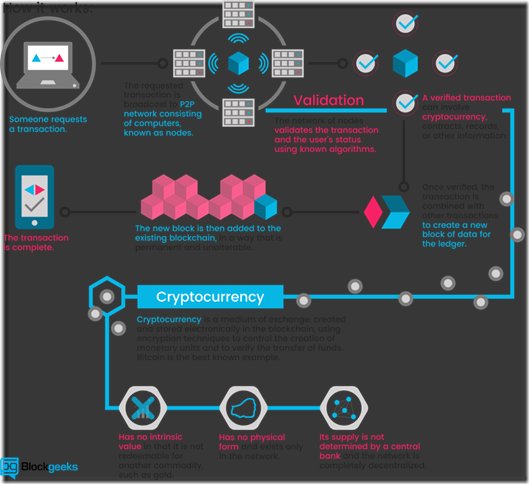
image-1-1024x936
A transfer of funds between two digital wallets is called a transaction. That transaction gets submitted to a public ledger and awaits confirmation. When a transaction is made, wallets use an encrypted electronic signature (an encrypted piece of data called a cryptographic signature) to provide a mathematical proof that the transaction is coming from the owner of the wallet. The confirmation process takes a bit of time (ten minutes for bitcoin) while “miners” mine. Mining confirms the transactions and adds them to the public ledger.

Thursday, January 26, 2017

Only Siva temple Re-built by British-Baijnath Mahadev Temple

Baijnath Mahadev Temple is located in southern banks of Banganga river in Agar Malwa of Madhya Pradesh, India. The Shiv Ling (the sacred stone form of Lord Shiva) in the Baijnath temple is believed to belong to 13th century, while some legends say it is probably more than thousand years old. As written in the foundation stone of the temple at the end of 16th century, the local inhabitants built a small mutt like mandhir and mandap (a type of small temple structure). Then after 300 years, in 1883, with the inspiration from British army Hindu officials, and financial help of British Commander Lt. Colonel C. Martin and other local people, 11000 rupees was donated for the renovation of the temple, making it large, and also building few other temples around it.

There is also another piece of writing on one of the pillars in middle of the temple suggesting that it was built (renovated) with the orders of C. Martin in 1883. The official website of Shajapur district in Madhya Pradesh (shajapur.nic.in), where this temple is located, also mentions about this story. It is said that when the British Commander Martin was in a war, his wife went to Baijnath mahadev temple and made a request for his returning. Then Martin successfully came back from the war, and thereafter a beautiful temple was constructed.

Legend around the temple
In 1879, when the British were ruling India, Lt. Col. Martin of Agar Malva was leading the army in the war against Afghanistan.
Col. Martin used to regularly send messages of his well-being to his wife. The war continued for long & Lady Martin stopped getting messages. She was very upset.
Once riding on her horse, she passed by the temple of Baijnath Mahadev. She was attracted by the sound of Conch & Mantra. She went inside and came to know that the Brahmanas were worshipping Lord Shiva. They saw her sad face and asked her problem. She explained everything to them. They told her that Lord Shiva listens to the prayers of devotees and takes them out of difficult situations in no time. With the advice of the Brahmanas she started the ‘Laghurudri Anushtthan’ of the Mantra:
‘Om Namah Shivaya’ for 11 days. She prayed to Lord Shiva that if her husband reaches home safely, then she would get the temple renovated.

On the last of the ‘Laghurudri’ a messenger came and gave a letter to her. Her husband had written: ‘I was regularly sending messages to you from the battle grounds but suddenly the Pathans surrounded us from all sides. We were entrapped in a situation where there was no scope of escaping death. Suddenly I saw a Yogi of India with long hair, carrying a weapon with three pointers (Trishul). His personality was amazing and he was maneuvering his weapon with a magnificent style. Seeing this great man, the Pathans started running back. With his grace our bad times turned into moments of victory. This was possible only because of that man of India wearing a lion skin & carrying a three-pointer weapon (Trishul). That great Yogi told me that I should not worry and that he had come to rescue me because he was very pleased with my wife’s prayers.’

Tears of joy were falling down Lady Martin’s eyes while reading the letter. Her heart was overwhelmed. She fell into the feet of Lord Shiva’s statue and burst in tears.
After a few weeks Col. Martin returned. Lady Martin narrated the whole incident to him. Now both husband & wife became devotees of Lord Shiva. In 1883 they donated Rs. 15,000 for renovating the temple. The information engraved slab for the same is still there in the Baijnath Mahadev Temple of Agar Malva. This is the only Hindu temple built by a Britisher

Monday, January 23, 2017

Women with X-Ray Vision - Natasha Demkina


German physicist Wilhelm Roentgen announced his discovery of an invisible form of radiation that could make photographs of bones and organs inside a living human body. At first, many scientists called the discovery of "X-rays" a hoax, but when the skeptics put Roentgen's claims to the test, they quickly were convinced about one of the greatest discoveries in science and medicine. Indeed, just six years after his discovery, Roentgen was awarded the first Nobel Prize in physics.


Would you believe if I told you this women Natalya "Natasha" Nikolayevna Demkina can do the same as Roentgen inventation with her own eyes and its true.In 2004 she appeared on television shows in the United Kingdom, on the Discovery Channel and in Japan. Since 2004 Demkina has been a full-time student of the Semashko State Stomatological University, Moscow. Since January 2006, Demkina has worked for the Center of Special Diagnostics of the Natalya Demkina (TSSD), whose stated purpose is to diagnose and treat illness in cooperation with "experts possessing unusual abilities, folk healers and professionals of traditional medicine."


Natasha Demkina has a growing number of patients, doctors, journalists, and others who are convinced her powers are real. That following is proving lucrative for Natasha and her family. The young psychic reportedly charged about $13 per reading and provided about ten readings each weekday night. That income, about $2,600 a month, is more than forty times the average monthly income of government workers in Saransk.


Click here to view more on report on Natasha done by CSI

Japan: Abandoned Buddhist temple turned into bra sanctuary

Locals and visitors are calling an abandoned Buddhist temple situated in Ibaraki, a remote area in Tokyo, a bra sanctuary. Someone has covered the temple, closed over a fraud case involving alleged fortune telling, with bras and naked Barbie dolls. The temple has begun to charge tourists a fee for visiting the premises.

5 world's narrowest street

1.Spreuerhofstraße,Germany

Spreuerhofstraße is the world's narrowest street, found in the city of Reutlingen, Germany It ranges from 31 centimetres (12.2 in) at its narrowest to 50 centimetres (19.7 in) at its widest.The lane was built in 1727 during the reconstruction efforts after the area was completely destroyed in the massive city-wide fire of 1726 and is officially listed in the Land-Registry Office as City Street Number 77.

2.L'Androuno,France

L'Androuno is one of the world's narrowest streets,found in the city of Gassin, France.It measures 29 centimeters (11.41 inches) at its narrowest point.


3.Fan Tan Alley

Fan Tan Alley is an alley in Victoria, British Columbia's Chinatown. It runs south from Fisgard Avenue to Pandora Avenue in the block between Government Street and Store Street. It was originally a gambling district with restaurants, shops, and opium dens. Today it is a tourist destination with many small shops including a barber shop, art gallery, Chinese cafe, apartments and offices. It is the narrowest street in Canada. At its narrowest point it is only 0.9 metres (35 in) wide. It was designated as a heritage property by the local government in 2001

4.Mårten Trotzigs Gränd


Mårten Trotzigs gränd (Swedish: "Alley of Mårten Trotzig") is an alley in Gamla stan, the old town of Stockholm, Sweden. Leading from Västerlånggatan and Järntorget up to Prästgatan and Tyska Stallplan, the width of its 36 steps tapers down to a mere 90 centimetres (35 in), making the alley the narrowest street in Stockholm.

5.Parliament Street, Exeter

Parliament Street is a 50-metre (160 ft) long street in the city of Exeter, Devon, England. It links the High Street to Waterbeer Street and dates from the 14th century. At about 0.64 metres (2 ft 1 in) at its narrowest and approximately 1.22 metres (4 ft 0 in) at its widest, it has been claimed to be the world's narrowest street,although this title actually belongs to the Spreuerhofstraße in Reutlingen, Germany.

It was formerly called Small Lane and was renamed when Parliament was derided by the city council for passing the 1832 Reform Bill.In 1836 the residents of Waterbeer Street subscribed £130 to have Parliament Street widened, but nothing was done about this.

An App to test Male potency - YO Sperm

Yes you heard me right ..!! With Yo Sperm you could actually test if your Sperm is fertile.

YO Sperm Test from Medical Electronic Systems is a $50 male fertility kit that is FDA approved for at-home use. It includes everything needed to collect a sample, including a sample collection cup, a testing slide, a plastic pipette, and a special liquefying powder. A mini-microscope attaches to a smartphone’s camera and measures sperm motility — the ability to move spontaneously and actively — and count, and even lets interested parties watch swimmers on their smartphone’s screen.

Once the supplies are assembled and the sample produced, users mix the aforementioned powder into the collection cup, swirl it around for 10 to 15 seconds and let it rest for 10 minutes. After a bit of the sample’s piped onto the slide and inserted into the clip, the app takes and analyzes a 30-second video.

The commercial-grade semen analyzer is 97 percent accurate, the company says, and the results are encrypted in the companion app’s special health report vault. It’s geared specifically toward men who want to know more about their reproductive health, or who want to know if reproductive problems are the result of infertility.

“The explosion of apps and wearables dedicated to optimizing the chance of pregnancy is evidenced [by the fact] that people crave more awareness of their fertility status. However, the bulk of these new technology tools cater to women. No other company is tackling male reproductive health in this manner,” Marcia Deutsch, CEO of Medical Electronic Systems, said in a statement.

“If a man is producing 100 million sperm and they are all dead or not swimming, it’s useless to know your sperm concentration is “normal.” The key is to assess sperm that are moving, as these are the sperm that will fertilize an egg during normal conception,” Deutsch said. “YO is trailblazing a new approach [by] offering consumers valuable and reliable information and bringing clarity to one of life’s biggest moments, that of starting a family.”


The kit is compatible with the Samsung Galaxy S6, S7, and all recent models of iPhone with the exception of the Plus variants. It’s available from the Medical Electronic Systems website.


You could pre-order your device here


World's Most dangerous airport-Kasai International Airport,Japan

Kansai International Airport  is an international airport located on an artificial island in the middle of Osaka Bay, 38 km (24 mi) southwest of Ōsaka Station, located within three municipalities, including Izumisano (north), Sennan (south), and Tajiri (central), in Osaka Prefecture, Japan. The airport is off the Honshu shore and was designed by Italian architect Renzo Piano. The airport serves as an international hub for All Nippon Airways, Japan Airlines, and Nippon Cargo Airlines, and also serves as a hub for Peach, the first international low-cost carrier in Japan.

An artificial island, 4 km (2.5 mi) long and 2.5 km (1.6 mi) wide, was proposed. Engineers needed to overcome the extremely high risks of earthquakes and typhoons (with storm surges of up to 3 m (10 ft)).

Construction started in 1987. The sea wall was finished in 1989 (made of rock and 48,000 tetrapods). Three mountains were excavated for 21,000,000 m3 (27,000,000 cu yd) of landfill. 10 000 workers and 10 million work hours over three years, using eighty ships, were needed to complete the 30-metre (98 ft) layer of earth over the sea floor and inside the sea wall. In 1990, a three kilometer bridge was completed to connect the island to the mainland at Rinku Town, at a cost of $1 billion.[citation needed] Completion of the artificial island increased the area of Osaka Prefecture just enough to move it past Kagawa Prefecture in size (leaving Kagawa as the smallest by area in Japan).

The bidding and construction of the airport was a source of international trade friction during the late 1980s and early 1990s. Prime Minister Yasuhiro Nakasone responded to American concerns, particularly from Senator Frank Murkowski, that bids would be rigged in Japanese companies' favour by providing special offices for prospective international contractors, which ultimately did little to ease the participation of foreign contractors in the bidding process. Later, foreign airlines complained that two-thirds of the departure hall counter space had been allocated to Japanese carriers, disproportionately to the actual carriage of passengers through the airport.

The island had been predicted to sink 5.7 m (19 ft) by the most optimistic estimate as the weight of the material used for construction compressed the seabed silts. However, by 1999, the island had sunk 8.2 m (27 ft) – much more than predicted. The project became the most expensive civil works project in modern history after twenty years of planning, three years of construction and fifteen billion (US) dollars of investment. Much of what was learned went into the successful artificial islands in silt deposits for New Kitakyushu Airport, Kobe Airport, and Chūbu Centrair International Airport. The lessons of Kansai Airport were also applied in the construction of Hong Kong International Airport.

In 1991, the terminal construction commenced. To compensate for the sinking of the island, adjustable columns were designed to support the terminal building. These are extended by inserting thick metal plates at their bases. Government officials proposed reducing the length of the terminal to cut costs, but architect Renzo Piano insisted on keeping the terminal at its full planned length. The airport opened in 1994.

On 17 January 1995, Japan was struck by the Kobe earthquake, whose epicenter was about 20 km (12 mi) away from KIX and killed 6,434 people on Japan's main island of Honshū. Due to its earthquake engineering, the airport emerged unscathed, mostly due to the use of sliding joints. Even the glass in the windows remained intact. In 1998, the airport survived a typhoon with wind speeds of up to 200 km/h (120 mph).