Thursday, October 1, 2009

Dust storm in Australia


A huge outback dust storm - 500 km (310 mi) wide by 1,000 km (620 mi) long - swept across eastern Australia and blanketed Sydney on Wednesday, September 23rd, disrupting flights and ground transportation and forcing people indoors for shelter from the hazardous air, gale-force winds, and in some places hailstorms. Those few who ventured outside, especially at dawn, were greeted by a Martian sky, familiar landmarks blotted out by the heavy red dust blowing by. Collected here are a few photos of the worst dust storm Sydney has seen in 70 years, three of which you can click to see a before/after fade effect.
(26 photos total)

Remembering Apollo 11

40 years ago, three human beings - with the help of many thousands of others - left our planet on a successful journey to our Moon, setting foot on another world for the first time. Tomorrow marks the 40th anniversary of the July 16, 1969 launch of Apollo 11, with astronauts Neil A. Armstrong, Michael Collins and Edwin E. "Buzz" Aldrin Jr. aboard. The entire trip lasted only 8 days, the time spent on the surface was less than one day, the entire time spent walking on the moon, a mere 2 1/2 hours - but they were surely historic hours. Scientific experiments were deployed (at least one still in use today), samples were collected, and photographs were taken to document the entire journey. Collected here are 40 images from that journey four decades ago, when, in the words of astronaut Buzz Aldrin: "In this one moment, the world came together in peace for all mankind".


View FrOm Lunar Terrain

Iran Nuclear Talks Begin in Geneva


GENEVA -- As world powers began a key meeting with Iran Thursday aimed at reining in the country's nuclear-fuel program, all eyes are on whether Tehran will agree to discuss limitations on a program it insists is for civilian use.

The meeting at a villa on Lake Geneva in Switzerland marks the first time the U.S. has taken part in such talks as a full participant, and comes just days after the revelation that Iran has been developing a second uranium-enrichment plant in secret, further cementing the belief in Western capitals that Iran wants the technology to develop nuclear weapons.

U.S. Under-secretary of State William Burns sat alongside EU foreign affairs chief Javier Solana at the opening of the talks in Geneva.
The morning session of the meeting consisted of a restatement of positions by both sides, according to a Western diplomat familiar with the talks. The diplomat said the Europeans present re-proposed their offer for staged talks, while stressing that the revelation of a new secret site had made a solution to the diplomatic impasse urgent.

Iran reiterated the broad range of issues it wants to discuss, touching on the nuclear question only toward the end. "The key session will be this afternoon," the diplomat said.

The United Nations Security Council members and Germany -- known as the P5+1-- believe the exposure of the second enrichment site has given them new leverage to persuade Iran to agree to a "freeze-for-freeze" proposal. Under the proposal, Iran would stop expanding its fuel program in exchange for a halt to new U.N. sanctions. That temporary pause would set the stage for more wide-ranging talks, offering Iran trade and economic benefits in exchange for a permanent solution, such as suspension of its nuclear fuel program.

The U.S., Russia, China, France, U.K. and Germany also hope to get Iranian assurances Thursday that it will open itself up fully and quickly to international inspectors, particularly at the newly exposed site at Qom.

Thursday's meeting is a key test of whether Iran is willing to engage on these issues, or whether the P5+1 will have to move away from diplomacy toward sanctions, diplomats familiar with the talks said.

Mohamed ElBaradei, who heads the International Atomic Energy Agency, said Wednesday in comments to television that Iran was "on the wrong side of the law" in maintaining that it had had no obligation to tell the agency about the site at Qom until it was ready to introduce nuclear material there. Mr. ElBaradei's comments were taken as significant, given his relatively soft approach to pressuring Iran in the past.

While Thursday's meeting isn't expected to address the issue of new sanctions, European members of the P5+1 are pushing for quick action if Iran fails to persuade the group that it is willing to engage to find a solution to concerns over its fuel program. The facilities Iran is developing can enrich uranium to weapons grade or to be used in civilian power plants.


U.S., Iran Make Offers on Nuclear Talks
IAEA Awaits Word on Iran Inspections
Speaking to Echo Moskvy radio in Moscow Thursday morning, French Foreign Minister Bernard Kouchner said: "I am not a fanatic supporter of sanctions against people. Sometimes, yes, they are useful, but we are not yet talking about sanctions. In Geneva, we won't be talking about sanctions."

At the same time, Mr. Kouchner said he wasn't overly concerned by the hard line his Russian opposite, Sergei Lavrov, has taken against further U.N. sanctions. He said it wouldn't be the first time Mr. Lavrov had opposed sanctions only to be overruled by President Dmitry Medvedev. He also noted that the Security Council, where Russia and China have a veto, has already passed three resolutions against Iran that include sanctions.

In recent months, Europe -- and France in particular -- has traded roles with the U.S., taking a tougher and more vocal approach to pressuring Iran while the U.S. has used more cautious language. However, European leaders have signed on to the U.S. timetable requiring Iran to show it is willing to engage seriously on the nuclear issue by the end of the year.

"If Iran does not respond to the demands of the International Atomic Energy
Agency by December, the international community must decide on sanctions," French Defense Minister Herve Morin told Le Figaro newspaper in an interview Thursday.

Thursday's meeting is at the level of political directors, rather than foreign ministers. The EU's foreign policy representative, Javier Solana, who has acted as point man for the P5+1 in negotiations with Iran, opened the talks, which are expected to last all day.

A senior U.S. official said Wednesday that the U.S. would be open to a one-on-one meeting with Iran during the talks, marking the administration's effort to engage Iran. Negotiations with Iran over its nuclear program have been going on since 2003, but have achieved little in the face of Iran's tough line maintaining its right to develop the technology and insistence to date that its program is for civilian use only.

Under the Nuclear Proliferation Treaty, to which Iran is a signatory, countries do have the right to enrich uranium. However, the confirmation in 2003 that Tehran had been developing uranium-enrichment technologies in secret for as long as 18 years triggered deep mistrust in Western capitals over the purpose of the program.

Talks have gained urgency over the past year amid rising concerns that Iran already has enough nuclear material for a bomb, if it chooses to enrich the material further.

Russia and the EU have offered repeatedly to provide Iran with fuel for civilian reactors, something Iran indicated this week it may be open to.

Vietnam fights floods after typhoon, toll hits 40


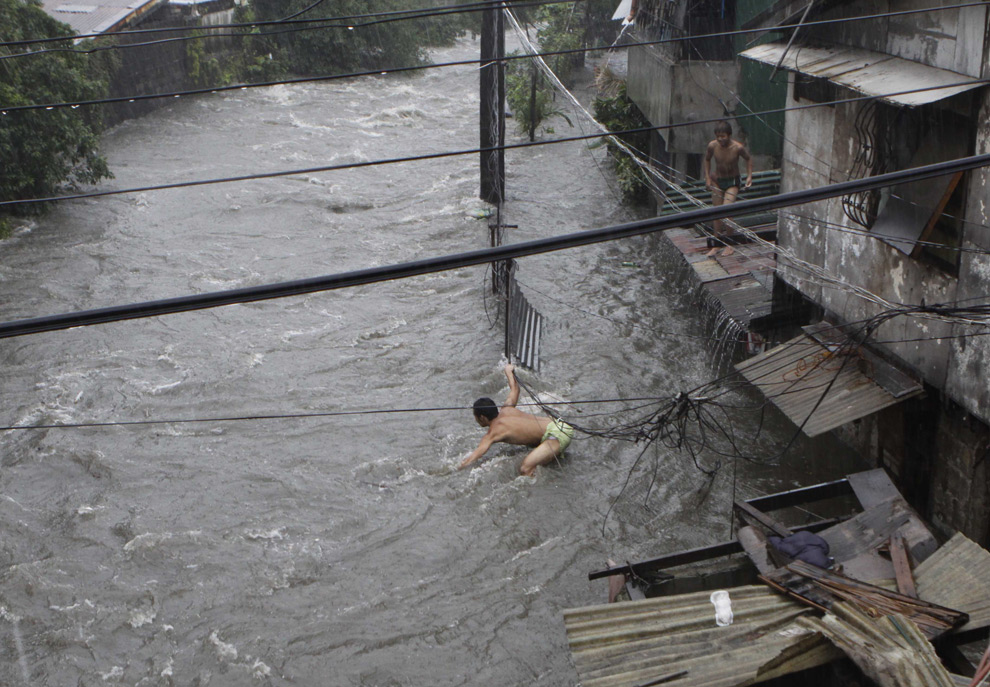
Government reports said torrential rains from Typhoon Ketsana, which swept into Vietnam late on Tuesday, killed 40 people and left 10 missing from floods and landslides in nine coastal and central highland provinces.

Ketsana hit the Philippines at the weekend, killing 246 people, leaving another 42 missing, and causing damages totaling more than $100 million, officials said.

Weather reports said that by late on Wednesday rivers in Vietnam's Quang Nam province could reach a level last seen in 1964.

The typhoon spared most of Daklak, Vietnam's top coffee-growing province, and officials were still assessing coffee and rubber trees in Gia Lai, the third-largest coffee grower, state-run Vietnam Television said.

Floodwaters had submerging some old houses in Quang Nam's Hoi An city, a UNESCO-recognized World Heritage site, where people had to move around by boat.

"We have had storms or flooding in the past, but this time we have both of them," Le Xuan Toan, a 45-year-old Hoi An resident, told Reuters while sitting on the roof of his submerged house.

Foreign tourists who took shelter in state buildings in Hoi An when the typhoon made landfall returned to hotels on Wednesday and some helped clean up the streets.

SHIPS TOSSED ASHORE

Floods from the typhoon damaged or destroyed 294,000 homes in central Vietnam. Around 357,000 people in 10 provinces were evacuated.

Sea waves threw several ships onshore in the port city of Danang, a Reuters witness said.

The region hit by Ketsana lies far north of Vietnam's Mekong Delta rice basket. The rain dumped on the Central Highlands coffee belt could delay the start of the next coffee harvest by up to 10 days but exports would not be affected, traders said.

Ketsana had weakened to a tropical storm after moving into Laos and Cambodia on Tuesday night, weather forecasters said.

Vietnam's Deputy Prime Minister Hoang Trung Hai urged the authorities to quickly resume power supplies to the typhoon-hit region, including Quang Ngai province, where Vietnam's first oil refinery, Dung Quat, was due to reopen on Wednesday after an outage halted the plant's test runs last month.

The 140,000 barrel per day plant will resume operations later on Wednesday as scheduled after repairs, a Petrovietnam official said, adding the typhoon had not damaged the facility.

The storm has become a focus of marathon climate talks in Bangkok this week, with developing nations and green groups saying it is an example of the type of climate disaster poor nations could face in a warmer world.

"Ketsana is clearly a manifestation of the consequences of global inaction in addressing the immediate impacts of creeping climate change," chief Philippine climate negotiator Heherson Alvarez told reporters.

He said rich nations must act urgently "to moderate these storms and spare the whole world from the impoverishing and devastating impacts of climate change."

Residents in Manila have been scathing in their criticism of the government's disaster response in the crowded city of 15 million where sewers are notoriously blocked by rubbish.

Ketsana dumped more than a month's worth of average rainfall on Manila and surrounding areas, forcing 375,000 out of their homes and destroying more than 180,000 tonnes of paddy rice.

Philippine lawmakers were set to pass a supplementary budget for 2009 of about 10 billion pesos ($211 million) for relief, recovery and rehabilitation efforts, Defense secretary Gilberto Teodoro said.

A new storm forming in the Pacific Ocean was likely to enter Philippine waters on Thursday and make landfall later on the northern island of Luzon, forecasters said.

Distracted driving blamed for 5,800 U.S. deaths

Transportation Secretary Ray LaHood Wednesday called distracted driving a serious epidemic with more than 5,800 annual U.S. traffic deaths tied to motorists who failed to keep their eyes on the road.

LaHood opened a two-day conference exploring research on cellphone use and text messaging while driving as well as other topics that can divert the attention of motorists.

"To put it plainly, distracted driving is a menace to society and it seems to be getting worse every year," LaHood said, adding that it was an "extraordinarily serious epidemic."

Figures released at the conference by the National Highway Traffic Safety Administration (NHTSA) showed more than 5,800 distracted driving deaths and 515,000 injuries last year.

The fatality figures released by the government on distraction did not break down crashes by specific driver behavior. Broadly, safety officials identified cellphone use, texting, eating, talking to passengers and manipulating radio or vehicle controls as distractions.

The proportion of deadly accidents tied to distracted driving climbed from 11 percent in 2004 to 16 percent in 2008, according to the figures culled from police reports. By comparison, drunken driving accounted for roughly 30 percent of all fatalities.

Drivers under 20 years old were involved in 16 percent of distracted-driver fatal crashes. Those ages 20 to 29 accounted for another 12 percent.

The figures were significant but may not show the full problem since identifying distraction as a cause of crashes, especially in fatal accidents, can be difficult, transportation officials and safety experts acknowledged.

"We're all trying to look at this as carefully as possible," said Adrian Lund, president of the Insurance Institute for Highway Safety. "There are some questions we need to answer."

For instance, Lund's group, which is funded by insurance companies and analyzes vehicle safety performance and other trends, said there is little overall information specifically on cellphone use and crashes -- a major target of states and federal officials.

There are also general safety contradictions as overall U.S. highway fatalities have declined. Police reports on crashes, an indicator of serious accidents, and auto-related property claims have also gone down.

"We're just uncertain how big the problem is," Lund said.

A separate survey released Wednesday by the Transportation Department showed 6 percent of drivers, or 812,000 people at any one time, used hand-held cellphones while driving in 2007. One percent used other hand-held devices to send text messages or read.

Auto manufacturers, the wireless industry, lawmakers and other groups support state and local efforts to ban texting while driving, but outlawing cellphone use behind the wheel has less support. Congress is also considering legislation to ban texting while driving.

Super rich are $300 billion lighter

he recession has taken its toll on the nation's super rich, whose collective net worth fell for only the fifth time in 28 years, according to a survey released Wednesday.

The collective worth of the 400 richest people fell by $300 billion, or 19%, to $1.27 trillion, according to the survey released by Forbes magazine.

As a result, the price of admission to appear on the list this year dropped to $950 million from $1.3 billion in the 2008 list.

The losses were driven by turmoil in the capital markets and plunging real estate values, according to the magazine. but fraud and divorce also took a toll.

The number of members who experienced year-over-year declines was more than double the number in 2008, with 314 of this year's list members declining in wealth compared to 126 last year.

Microsoft (MSFT, Fortune 500)'s Bill Gates, with assets worth $50 billion, topped the list of richest Americans. That's despite a $7 billion hit. Investor Warren Buffett came in second, with assets totaling $40 billion, after a $10 billion loss this year.

Oracle (ORCL, Fortune 500) founder Lawrence Ellison was the only top ten member to avoid major losses. Ellison, who was third overall, saw his net worth remain unchanged at $27 billion.

Among the 32 members who were booted off the list this year was disgraced financier R. Allen Stanford, who is accused of operating a Ponzi scheme.

ndonesia quake death toll 100-200: disaster agency


A powerful earthquake, which struck near the city of Padang on Indonesia's Sumatra island on Wednesday, has killed between 100 and 200 people, but thousands remain buried in rubble, officials said on Thursday morning.

Priyadi Kardono, spokesman for the national disaster agency, gave the death toll of 100-200 in the city of 900,000. About 500 houses had caved in, according to officials in the area.

By Thursday morning there were still "thousands of people trapped in the rubble of buildings," said Rustam Pakaya, the head of the health ministry's disaster center in Jakarta.

The 7.6 magnitude quake hit Padang, West Sumatra, on Wednesday afternoon. With communications to the area cut, officials have struggled to get details of casualties and damage.

The death toll was likely to rise as many buildings had collapsed, Vice President Jusuf Kalla told a late night news conference in Jakarta.


"The big buildings are down. The concrete buildings are all down, the hospitals, the main markets, down and burned. A lot of people died in there. A lot of places are burning," Australian businesswoman Jane Liddon told Australian radio from Padang.

"Most of the damage is in the town center in the big buildings. The little houses, the people's houses, there are a few damaged, but nothing dramatic. It's not all a rubble heap in terms of smaller buildings."

Australia's international Aid Minister Bob McMullan said he feared the death toll would be "large" and offered emergency assistance if it was required.

"We are, of course, ready to assist. They are very close friends and neighbors. They know that we are here and available to help. They just have to ask," he said.

SMASHED HOMES

TV footage showed piles of debris and smashed houses after the earthquake, which caused widespread panic. The main hospital had collapsed, roads were cut off by landslides and Metro Television said the roof of Padang airport had caved in.

The disaster is the latest in a spate of natural and man-made calamities to hit Indonesia, a sprawling archipelago of 226 million people.

Welfare Minister Aburizal Bakrie said on Wednesday that damage could be on a par with that caused by a 2006 quake in the central Java city of Yogyakarta that killed 5,000 people and damaged 150,000 homes.

"Hundreds of houses have been damaged along the road. There are some fires, bridges are cut and there is extreme panic here," said a Reuters witness in the city. Broken water pipes, he said, had triggered flooding.

His mobile phone was then cut off and officials said power had been severed in the city.

The quake was felt around the region, with some high-rise buildings in Singapore, 440 km (275 miles) to the northeast, evacuating staff. Office buildings also shook in the Malaysian capital, Kuala Lumpur.

Sumatra is home to some of the country's largest oil fields as well as its oldest liquefied natural gas terminal, although there were no immediate reports of damage. Padang, capital of Indonesia's West Sumatra province, sits on one of the world's most active fault lines along the "Ring of Fire" where the Indo-Australia plate grinds against the Eurasia plate to create regular tremors and sometimes quakes.

Geologists have long warned that Padang may one day be destroyed by a huge earthquake because of its location.

A 9.15 magnitude quake, with its epicenter roughly 600 km (373 miles) northwest of Padang, caused the 2004 tsunami which killed 232,000 people in Indonesia's Aceh province, Thailand, Sri Lanka, India, and other countries across the Indian Ocean.

The depth of Wednesday's earthquake was 85 km (53 miles), the United States Geological Survey said. It revised down the magnitude of the quake from 7.9 to 7.6.